

10 endangered species we need to be serious about!
Copy this code to embed the top 10:
Adverse changes in the environment has brought dire changes in the functioning of our ecosystem. The biggest threat looms over the wildlife members of our ecological community, birds and animals. The fact that smallest changes in the food chain or food web can cause intricate disruptions has been one of the least concerns of the world population. Excessive human intervention, forest-fires, overgrazing, mining, urbanization and other anthropogenic activities has disrupted the biomes and has posed irreversible threat on our environment. Here is a list of few species which are either critically endangered or on the verge of extinction.
-
10

Blackbuck
- Antilope cervicapra (Linnaeus) : It has been classified as endangered by the IUCN list in 2003. Left as the only surviving species of Antilope family, blackbuck is confined to states such as in Maharashtra, Odisha, Punjab, Rajasthan, Haryana, Gujarat, Andhra Pradesh, Tamil Nadu, and Karnataka. These are extremely fast grazers. Excessive hunting, poaching and encroachment into their habitable areas has put a serious threat on their existence. It was this blackbuck whose hunting led to acquittal of superstar Salman Khan. These hebivores have rich biological importance and need to be protected.
-
20

White Bellied Heron
Being a rare bird species, it is found in only selective sites of Assam, Arunachal Pradesh and Bhutan. This world's second largest heron is facing a diminishing population. Disturbance in habitat areasand harvesting of wetland sources has made them so critically endangered and as low as 250 left in the world of which 50 is in India. Although it breeds specifically in Namdapha Tiger Reserves, it is also found is other protected areas.
-
30

Lion-tailed macaque
Endemic to western ghats of southern India, less than 4000 of this species is left in India. This animal with magnificent tail and mane gives the nomenclature. Deforestation, logging, construction of water reservoirs, habitat fragmentation, conversion to farmland has led to its slow extinction. It is an aboreal species which lives in evergreen forests and feeds on fruits and insects. Serious conservation methods are needed to maintain these delicate parts of ecology.
-
40

Forest Owlet
It is in the high-risk condition according to the list of IUCN. After many years in was found 100 km away from Mumbai in western ghats. The Hindu newspaper reported that it was considered extinct for 113 years unless found in Toranmal Reserve Forest near Shahada in the Satpuda ranges in Maharashtra in 1997. As estimated only 50 to 250 are left worldwide. It feeds on rodents, grasshoppers, lizards, birds and frogs. Superstitious beliefs of killing owlet to make one fertile and excessive human intrusion into environment has rendered it critically endangered.
[caption id="attachment_6436" align="aligncenter" width="513"] A Forest Owlet found in Melghat, Maharashtra. The discovery of 'Forest Owlet', listed as one facing a high risk of extinction, in the Western Ghats has brought new hope about its survival.[/caption]
-
50

Olive Ridley turtles
Named after olive color of its heart shaped shell, Olive Ridley is one of the samllest sea turtles weighing around 80 to 100 pounds. It occurs in the tropical and warm temperate ranges of Pacific, Atlantic and Indian oceans. Commercial fishing, illegal harvesting and loss of nesting habitat has led to its decline. Their mass nesting is often destroyed by high-tides. An NGO, Tree Foundation which helps turtle conservation reported that almost 154 of these turtles were found dead in Nagapattinam shores. The presence of these turtles are extremely fundamental to the marine ecosystem and also help maintain coral reefs and sea grass beds.
[caption id="attachment_6438" align="aligncenter" width="635"] A Forest Department staffer in Puducherry burying the dead olive ridley turtles on the beach in Narambai.[/caption]
-
Advertisement
-
60
Greater One-Horned Rhino
It is one of the largest of the rhino species and found in the northern part of Indian subcontinent. Their presence matters because they help protect the species in their surroundings. The illegal trade of rhinos for traditional Asian medicines, and rampant poaching has led to lessening of their number to approximately 3000.
-
70

Vultures
Three species found in northern and north-eastern Cambodia, red-headed vulture (Sarcogyps calvus), white-rumped vulture (Gyps bengalensis), and slender-billed vulture are under IUCN's list of critically endangered species. Their presence holds significant importance in the ecosystem as they help clean carcass of animals. A Diclofenac drug was extensively used in South-Asia(2006) to treat livestock, and as these vultures fed upon them, their population decreased at a rate of 95 per cent due to poisoning. Thereafter the drug was banned.
-
80

The Great Indian Bustard
This rare ground bird is found in India and Pakistan. It is considered to be a top gaming bird, eventually leading to its hunting and decline. It is extinct from 90% of its habitable areas. Few of them are surviving in Thar desert of western India and Deccan peninsula in South and Sind of Pakistan. Encroached agriculture and illegal poaching are reasons for its decrease.
[caption id="attachment_6454" align="aligncenter" width="513"] A 2010 file photo of the Great Indian Bustard sighted in Siruguppa taluk, Karnataka[/caption]
-
90

Asiatic Lion-
An estimated number of 523 lions are left, and found only in Gujrat's Gir Forest National Park and Wildlife Sanctuary. Hunting, poaching, electrification by fences and poisoning are some of the reasons it has become an endangered species.
-
100
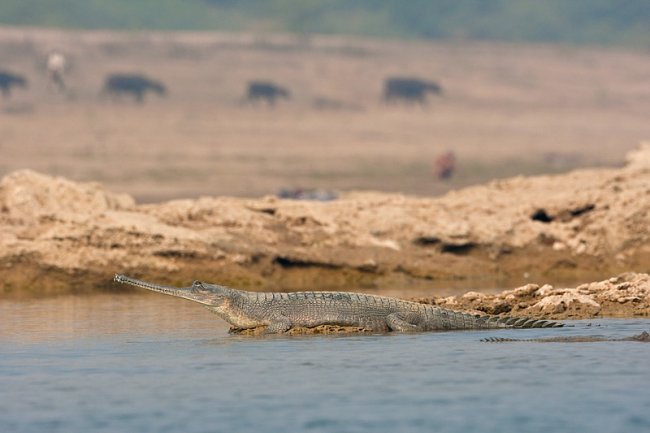
Gharial
It is a fish eating species of crocodile which survives in clean rivers with sand banks. Currently their population is spread across Uttar Pradesh, Rajasthan, and Madhya Pradesh in India.Their presence counts in Son River,Girwa River,the Ganges, Mahanadi river and the Chambal river. The construction of dams, barrages, embankments, water pollution, hunting for skin, sand-mining and other such man-made reasons have made them endangered.
More Lists You Might Like



Frequently Asked Questions
How is this list of endangered species ranked?
Why are species like the Great Indian Bustard and White Bellied Heron critically endangered?
What are the main threats to endangered species like Olive Ridley turtles and Vultures?
How can individuals help protect these endangered species?
Missing something?
Suggest an addition. Submissions are reviewed before appearing on the list.